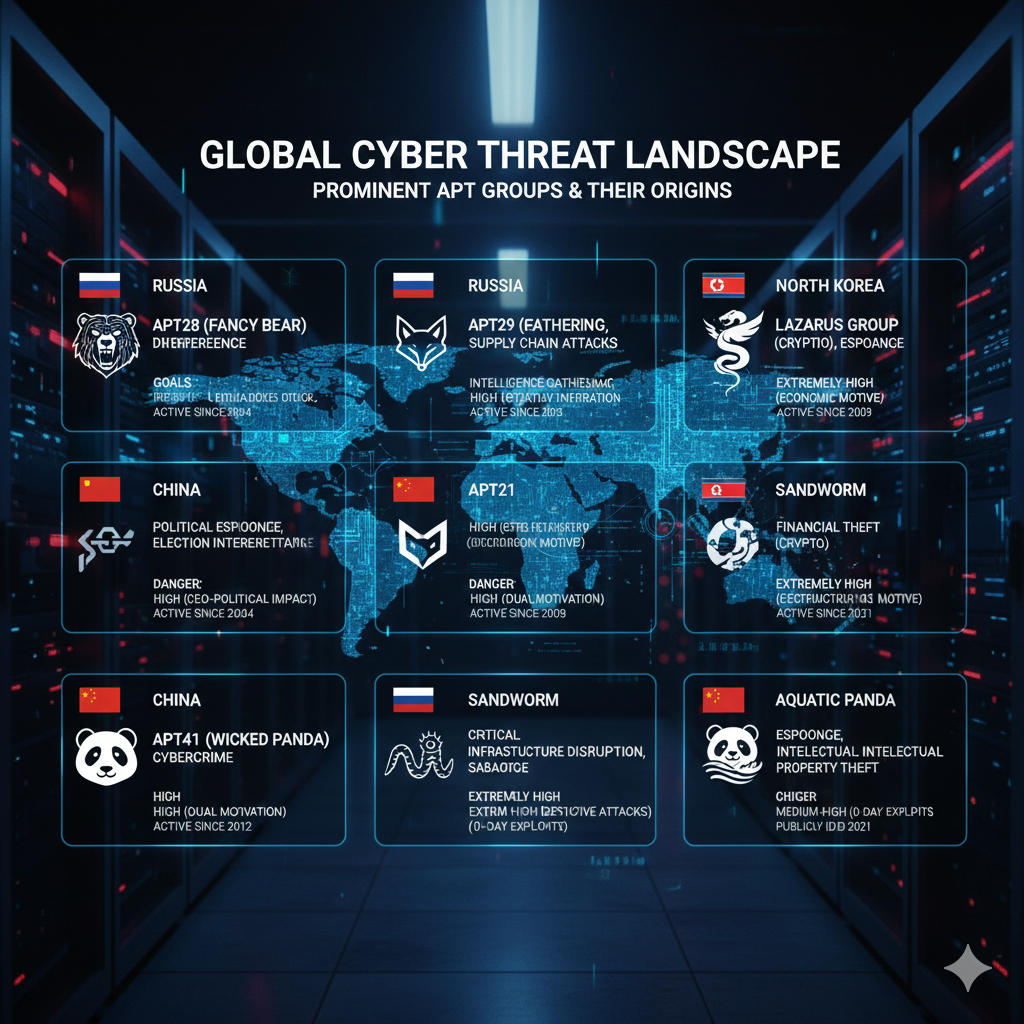
Advanced Persistent Threat (APT) groups represent some of the most sophisticated and dangerous actors in the cyber realm. Often state-sponsored, these groups engage in long-term, highly targeted campaigns to achieve specific strategic objectives, ranging from espionage to intellectual property theft and critical infrastructure disruption. Keeping track of their activities is crucial for global cybersecurity.
Here’s a look at some prominent and recently active APT groups:
1. APT28 (Fancy Bear / Strontium)
- Country of Origin: Russia
- Goals: Primarily military and political intelligence gathering, election interference, destabilization campaigns. They target government entities, defense organizations, media, and political organizations worldwide.
- Danger: High. Known for highly effective spear-phishing, zero-day exploits, and consistent adaptation. Their operations have directly impacted geopolitical events.
- Recent Activity (Example): Active throughout 2022-2023, particularly targeting NATO countries and organizations providing support to Ukraine, attempting to gather intelligence on military and political developments.
- Date: First publicly identified around 2004, but continuously active.
2. APT29 (Cozy Bear / Nobelium / Midnight Blizzard)
- Country of Origin: Russia
- Goals: Intelligence gathering, particularly political, diplomatic, and economic intelligence. They target government agencies, diplomatic missions, think tanks, and technology companies.
- Danger: High. Renowned for stealthy, long-term infiltration, supply chain attacks (e.g., SolarWinds), and sophisticated evasion techniques.
- Recent Activity (Example): Persistent targeting of cloud services, IT companies, and organizations involved in the global COVID-19 response. Continuing to adapt post-SolarWinds with new tactics.
- Date: First publicly identified around 2008, continuously active.
3. Lazarus Group (APT38 / Guardians of Peace / BlueNoroff / Famous Chollima)
- Country of Origin: North Korea
- Goals: Primarily financial gain through cyber theft (cryptocurrency, banking), but also espionage and sabotage to support the North Korean regime.
- Danger: Extremely High. Unique among state-sponsored groups for its focus on large-scale financial theft. Highly persistent and resourceful.
- Recent Activity (Example): Continual large-scale cryptocurrency heists (e.g., Ronin Bridge hack), social engineering for remote worker infiltration (as discussed in the previous article), and targeting of financial institutions worldwide.
- Date: First publicly identified around 2009, with significant activity surges since 2014.
4. APT41 (Wicked Panda / Winnti Group / Barium)
- Country of Origin: China
- Goals: Dual objectives: state-sponsored espionage (targeting government, healthcare, high-tech, telecommunications for intellectual property) and financially motivated cybercrime for personal gain.
- Danger: High. Known for a wide array of custom tools, supply chain attacks, and rapid exploitation of vulnerabilities. Their blend of state and criminal motives makes them particularly complex.
- Recent Activity (Example): Continued exploitation of common web application vulnerabilities (e.g., through FortiGate devices) and targeting of gaming industry.
- Date: Active since at least 2012, with public identification in 2019.
5. Sandworm (APT28’s Sub-Group / Electrum / Voodoo Bear)
- Country of Origin: Russia
- Goals: Disruptive and destructive cyberattacks, particularly against critical infrastructure (energy grid), also involved in information warfare.
- Danger: Extremely High. Directly responsible for some of the most impactful and destructive cyberattacks in history, including power grid outages in Ukraine and NotPetya.
- Recent Activity (Example): Relentless targeting of Ukrainian critical infrastructure since 2022, including attempts to disrupt energy supplies, and broader information operations.
- Date: Active since at least 2009, with major disruptive events since 2015.
6. Aquatic Panda
- Country of Origin: China
- Goals: Espionage, focusing on intellectual property theft and sensitive data from various sectors including technology and manufacturing.
- Danger: Medium to High. Known for exploiting newly discovered vulnerabilities and using custom malware, often adapting quickly to defensive measures.
- Recent Activity (Example): Identified in 2021 for exploiting a critical vulnerability in the Apache Log4j library (Log4Shell) shortly after its public disclosure, targeting an unnamed organization in the manufacturing sector.
- Date: Publicly identified in late 2021, but operations likely began earlier.
This overview highlights the persistent and evolving nature of the APT threat. Understanding these groups, their motivations, and their methods is the first step in building more resilient cybersecurity defenses.